

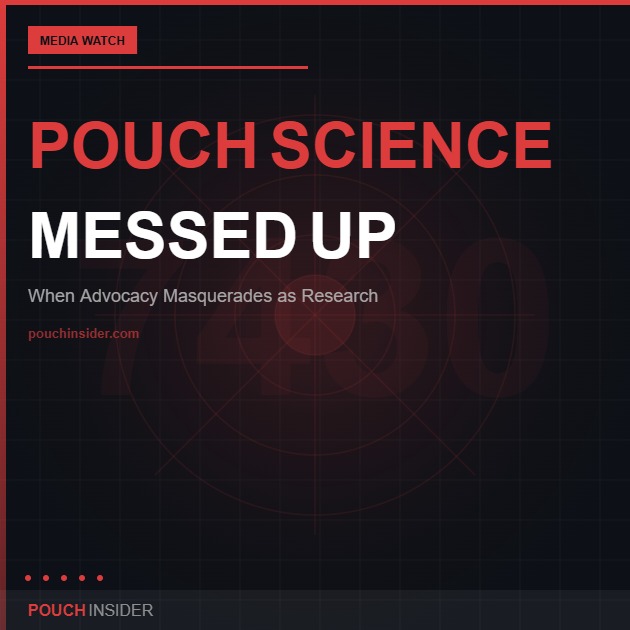

A paper circulated by researchers with strong ties to tobacco control advocacy organisations attracted attention for its treatment of nicotine pouch safety data — specifically, for a series of methodological choices that critics argued systematically overstated risk in ways that were not well-supported by the underlying evidence. The episode illustrates a recurring problem in this space: the difficulty of separating legitimate scientific concern from advocacy-driven science that wears the clothing of research.
The paper’s central claims involved extrapolation from studies on traditional smokeless tobacco products to modern nicotine pouches, treating the two as equivalent for risk assessment purposes. This is a move that a significant number of researchers in the field have criticised as methodologically unsound. Traditional smokeless tobacco products and modern nicotine pouches share a delivery mechanism but differ substantially in composition — specifically in tobacco-specific nitrosamine content, which is among the primary drivers of cancer risk in traditional smokeless tobacco.
When critics pointed this out, the response was defensive rather than engaged. The authors maintained their equivalence assumption while declining to address the specific compositional differences that make that assumption contestable. This pattern — of making a strong claim, receiving specific methodological criticism, and responding with generalities — is not unique to this paper but is a recurring feature of advocacy-adjacent research in tobacco control.
The Smoke-Free Partnership, a European tobacco control organisation, has historically maintained an anti-harm-reduction stance that treats the reduction of all nicotine use as the primary goal rather than the reduction of combustible tobacco use specifically. Papers produced by researchers affiliated with this ecosystem tend to reflect that framing, which is not inherently wrong but should be acknowledged when evaluating their conclusions.
Science that reaches predetermined conclusions is bad science regardless of which direction the conclusions run. The harm reduction field is not immune to this problem — there is promotional research produced by industry-adjacent researchers that deserves equally critical scrutiny. What good policy requires is the ability to distinguish between the two, which demands exactly the kind of methodological engagement that the response to this paper has not fully received.