

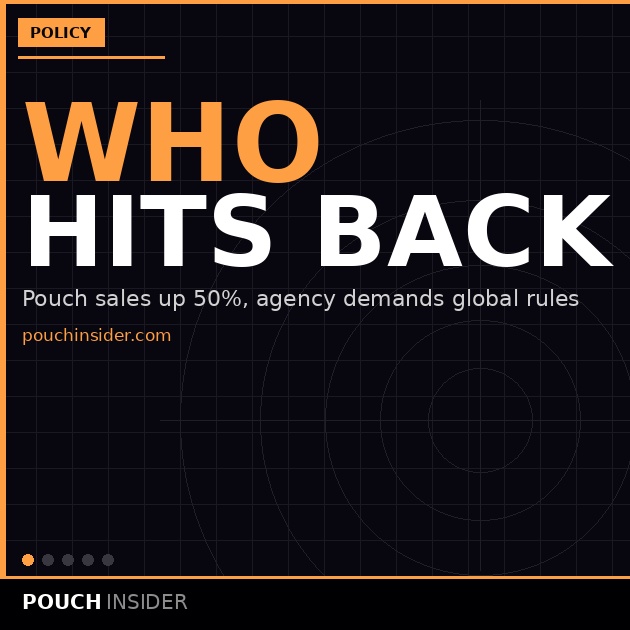

The World Health Organization is calling on governments worldwide to clamp down on nicotine pouches, after retail sales of the format crossed 23 billion units in 2024 — a jump of more than 50 percent compared with the prior year. The agency is asking states to adopt a sweeping package of restrictions, from flavor and advertising bans to plain packaging and product-specific taxes, framing the category as one that is expanding faster than regulators can respond to.
The push was unveiled around World No Tobacco Day, alongside a new WHO report titled “Uncovering the Marketing Tactics and Strategies Driving the Global Growth of Nicotine Pouches.” The agency estimates the global market for the products was worth roughly €6 billion in 2025, with the steepest growth concentrated in Europe and North America.
“Governments must act immediately”
The framing from the WHO was unusually direct. Vinayak Prasad, who heads the agency’s Tobacco-Free Initiative Unit, said at a press conference that “the use of nicotine pouches is spreading rapidly, while regulation struggles to keep pace. Governments must act immediately with robust, evidence-based protective measures.”
The recommended policy package includes:
- A ban on flavors in nicotine pouches
- A ban on advertising, promotion, and sponsorship, including via social media and influencers
- Stronger age verification at point of sale
- Stricter retail oversight
- Plain packaging and prominent health warnings
- Limits on permitted nicotine content per pouch
- Product-specific excise taxes to raise prices and reduce accessibility
The regulatory map: 160 countries with no specific rules
The WHO report estimates that around 160 countries still have no nicotine-pouch-specific regulation on the books. Sixteen countries have moved to ban sales outright, and another 32 have established some kind of regulatory framework. Among those 32, five restrict flavors, 26 restrict sales to minors, and 21 ban advertising, promotion, and sponsorship.
That patchwork is part of the reason brands have been able to scale so quickly. In jurisdictions where pouches are not classified as tobacco products, manufacturers can market through channels — including social platforms, sports sponsorships, and influencer programs — that have long been closed to cigarettes and even vapes.
Spain in the spotlight
WHO representative Ranti Fayokun singled out Spain as an example of a European market where the category has scaled fast. Fayokun said roughly five million cans are currently sold annually in Spain, with that figure potentially climbing to eight million.
Spain’s government approved a draft amendment to its 2005 anti-smoking law in 2025 that, for the first time, brings oral nicotine pouches under specific regulatory scrutiny — covering products made with either natural or synthetic nicotine and sold in sachet, powder, or tablet form. The amendment still needs to be processed and approved by the Cortes before it takes effect.
The youth marketing argument
Much of the WHO’s case rests on the argument that nicotine pouches are being aggressively marketed to adolescents and young adults. Etienne Krug, the WHO’s Director of Social Determinants of Health, said companies are using “deceptive tactics” — citing discreet, eye-catching packaging, candy-style flavors like bubblegum and gummy bears, and social media campaigns built around influencers.
The report also points to sponsorships of music festivals, concerts, and sporting events — Formula 1 is named specifically — as channels that put nicotine pouches in front of younger audiences. The agency also flags marketing language that, it argues, encourages discreet use in environments where smoking and vaping are off-limits, including schools.
Prasad warned that nicotine exposure during adolescence “can interfere with brain development, with possible effects on attention, memory, and learning,” and said early use raises the likelihood of long-term dependence and progression to other nicotine and tobacco products.
Not a cessation tool, WHO says
The agency also pushed back on the framing that pouches function as a smoking cessation or harm-reduction product. The WHO’s position is that any product marketed with smoking-cessation claims must first undergo rigorous scientific and regulatory evaluation — a bar that, in its view, no nicotine pouch brand has yet met.
“Products should not be marketed with implicit or explicit claims about smoking cessation unless they have undergone rigorous scientific and regulatory evaluation demonstrating their safety and efficacy,” Prasad said.
What this means for the industry
The WHO’s recommendations are not binding — member states implement them at their own pace, if at all. But the agency’s framing tends to set the tone for national regulators, particularly in Europe. The combination of flavor bans, advertising restrictions, and excise taxes is a familiar regulatory arc; it is essentially the playbook used against cigarettes over the last three decades, and the one applied to vapes more recently in the EU and UK.
For pouch manufacturers, the signal is that the relatively light-touch regulatory environment that allowed the category to scale to 23 billion units in 2024 is unlikely to last. Brands that have built their growth strategies around flavored SKUs, social media, and event sponsorships should expect those channels to come under tighter scrutiny over the next 12 to 24 months, particularly in markets where pouches have visibly broken through with younger consumers.