


Convenience-store retailers are watching the tobacco backbar reshape itself in real time, and the direction is unmistakable: smokeless nicotine — and pouches in particular — is taking share that vape used to own, while cigarettes continue their slow grind downward.
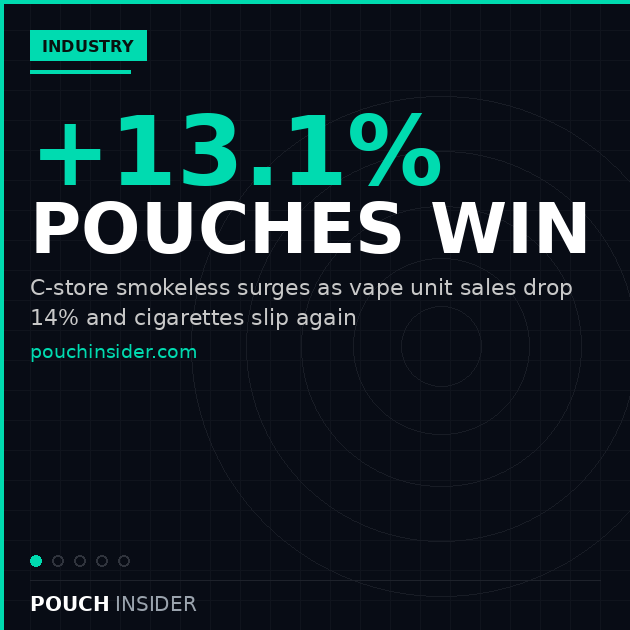
The numbers from the past 52 weeks tell a clear story. Smokeless tobacco saw a 13.1% increase in dollar sales in the c-store channel compared to last year, with an 11.3% jump in unit sales. Vapes moved the opposite direction, with dollar sales down 6.4% and unit sales down 14%. Traditional cigarettes still anchor the category at a commanding $50.7 billion, but even that footprint is eroding — dollar sales slid 0.6% and units fell 5.9%. Wikipedia
Operators on the ground are seeing the same pattern. At Englefield Oil’s Duchess chain, which runs more than 100 stores across Ohio and West Virginia, tobacco category manager Cal Honabarger said modern oral pouches are pulling the category forward while traditional smokeless tobacco keeps fading. He noted that vape, after years of volatility, appears to have stabilized. Consumers, he said, are clearly choosing nicotine formats that offer convenience, variety and discretion.
US Market, a 53-store chain across Oregon, Washington, Utah, Idaho and Texas, is reading the same signal. Amar Sidhu, director of business development, said customers are gravitating toward modern alternatives — vape and oral nicotine — because they offer more variety in flavor, format and overall experience than traditional tobacco. Pouches specifically, he noted, have built traction off three attributes: convenience, discretion and broader flavor selection.
The pattern repeats across regions. At Weigel’s, a 90-store operator in east Tennessee, director of loyalty and tobacco category manager Jessica Starnes said vape is in clear decline for the chain, traditional smokeless is flat, and nicotine pouches are putting up double-digit growth.
Behind the consumer shift sits a regulatory landscape that retailers are watching carefully. The FDA has been working through the premarket tobacco product application backlog, with only 45 vape products legally authorized to be marketed in the United States today. The agency moved to streamline the process in December 2025 by opening web-based submissions, and in early May notched a milestone by clearing Los Angeles manufacturer Glas’s Mango and Blueberry pods — the first non-tobacco, non-menthol flavored vape products to win authorization, with FDA citing the company’s device access restriction technology as central to its decision.
But the bigger drag on the legal vape market remains the illicit one. Alison Ritchie, president of the New York Association for Convenience Stores, said the vapor category continues to be dominated by illicit disposable products and noted that New York Governor Kathy Hochul has proposed vapor enforcement, or directory-style legislation, as part of her budget. NYACS is hoping the state moves to level the playing field for licensed retailers while penalizing the suppliers feeding the gray market.
Flavor bans are also shaping what hits the shelves. Honabarger said locations operating under flavor restrictions generate lower volume because they lack the assortment customers actually want. Sidhu echoed the compliance focus, saying his chain leans on trusted suppliers and ensures every product meets applicable regulatory standards before going into stores.
The takeaway for c-store operators is that the era of treating tobacco as a stable, predictable category is over. Honabarger said his team has had to become more agile and data-driven, actively redoing planograms and resetting fixtures to reflect the growing weight of modern oral nicotine. Sidhu described a more disciplined SKU evaluation process built around customer demand, compliance, brand reputation, supplier reliability, sales, margin and category balance — and explicitly resisting the temptation to chase high-margin products from less reliable partners.
What links every retailer interviewed is a recognition that pouches are no longer a side category. They are the growth engine of the tobacco backbar, and the operators winning 2026 are the ones building their planograms around that reality rather than fighting it.