


A new Léger survey commissioned by Imperial Tobacco Canada is putting hard numbers behind a warning the industry has been making for years: when Canadians can’t easily buy authorized nicotine pouch products, many simply turn to the black market instead.
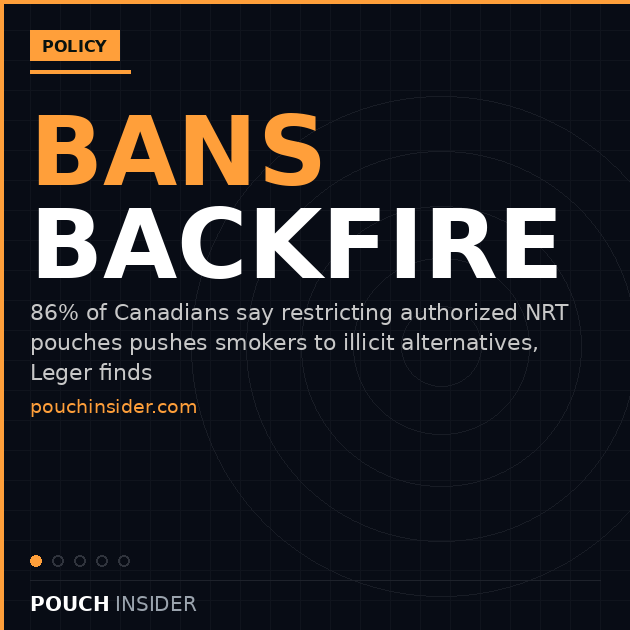
The polling, conducted online between January 27 and February 11, 2026, focused on adult smokers who also use nicotine pouches at least weekly. Among that group, 86% agreed that limiting access to Health Canada–authorized NRT pouches drives consumers toward purchasing illicit nicotine pouch alternatives. The findings underscore how Canada’s tightly controlled pharmacy-only model for authorized nicotine replacement therapy pouches may be working against its own goal of getting smokers off cigarettes. Yahoo!
Imperial Tobacco Canada is using the data to push for what it calls a more balanced cessation framework. The company isn’t arguing that pharmacists should be cut out — it’s arguing that they aren’t enough. The pitch is that age-controlled retail channels already trusted to sell cigarettes responsibly, namely convenience stores and gas stations, should also be able to offer authorized NRT pouches to the same adult consumers who walk in daily for tobacco.
Eric Gagnon, Vice President of Corporate and Regulatory Affairs at Imperial Tobacco Canada, framed the issue as a question of practical access rather than a knock on pharmacy. He said pharmacists play a meaningful role in helping adult smokers quit and should continue to be supported. But he argued that adult smokers shouldn’t be pushed toward unregulated products simply because the authorized options are too hard to find. Convenience stores and gas stations, he noted, are already entrusted with age-restricted categories and could form a controlled, regulated layer of access for authorized cessation products including NRT pouches.
The data lands at a sensitive moment for Canadian pouch policy. Health Canada has been criticized from both directions — by public-health advocates who want tighter restrictions on flavors and marketing, and by harm-reduction proponents who say overly narrow distribution rules are simply ceding the category to unregulated imports. Imperial’s argument is essentially that the second concern is now measurable: when 86% of users who straddle both products agree that restrictions push consumers to illicit channels, the policy debate stops being theoretical.
For retailers, the survey is also a signal of where Canadian pouch demand is genuinely sitting. Pharmacy may be the official channel, but the consumers buying these products skew heavily toward the same retail footprint where cigarettes are sold. Whether Ottawa moves to broaden authorized retail access remains to be seen — but Imperial has now put a number on the cost of not doing so.